
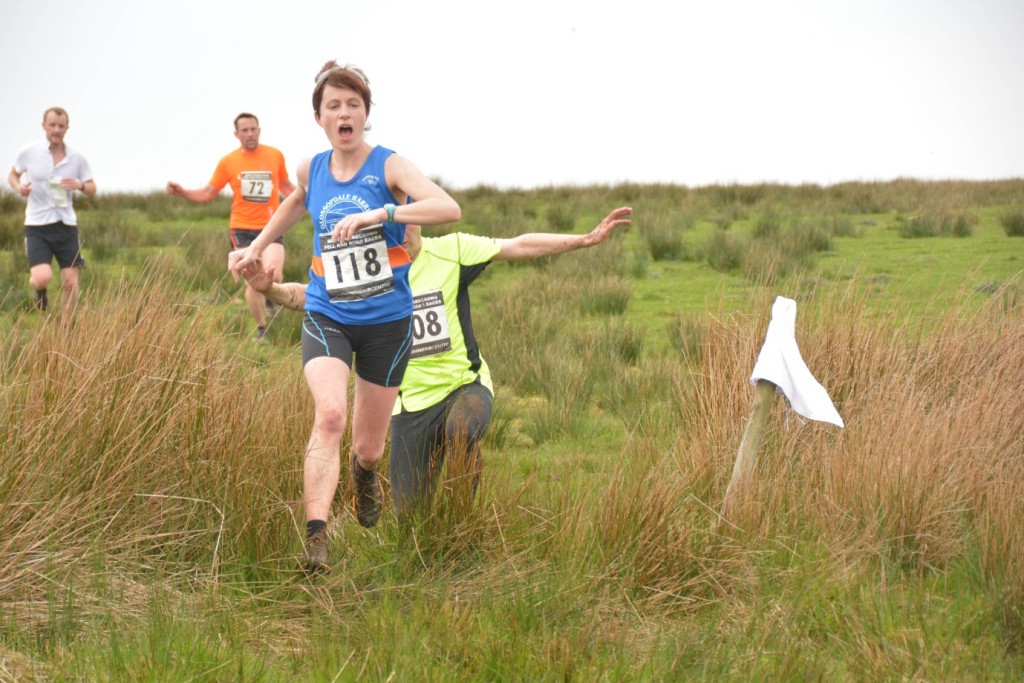
Today, Zoe Barton – friend, ex WI President and my Twitter running coach tells us about her newly discovered passion.
***************************************************************
Fellrunning. Fellrunners. Two words which used to baffle and boggle me. I was making an attempt on Scafell Pike on a beastly day, and as we clambered over greasy stones wobbling from step to step, cursing out loud, calves and toes screaming at us, out of the mist appeared two skinny guys in shorts with little backpacks, lithely bounding down from the cloud-obscured summit. The looks of ‘what crazy yet very brave and undoubtedly super fit tribe are these’ passed quickly among us. Within my ambitious self, a little spark ignited..
I didn’t know that there was a difference between a roadrunner and a fellrunner, not until I met Matt Dawson, a friend’s boyfriend who I knew was a runner. He knew I was training for my second marathon, that I liked hiking in the hills and that I was OK at running fast, and he invited me to try a fell run with him. I learned that I needed shoes with studs on the soles and a little bum bag to carry some essentials which basically boiled down to: some warm things to keep you alive until help reaches you if you sprain an ankle on a hail-swept moorland. I learned that it’s very much fun to run downhill with abandon, that when you dance up the paths next to hikers you get mumbled comments and nods of approval, and that when you run across the tops taking in the view and hearing the birds and beasts calling, it’s the best feeling in the world. I joined his running club the next week.
Since then my transformation has happened. I used to enjoy running a few 10k, half marathon and maybe a few off-road trail races each year. My aims this year include to complete the English Fell Running Championships series and rank myself amongst fellrunners nationally, and to do more ‘Long’ class fell races. What is a fell race? Back in history, when tourists began to visit the Lake District and Snowdonia, local shepherds and farmers would be employed as ‘Guides’ to show the visiting gentry the peaks and passes. At the village fairs, Guides Races were popular sport, and from there the pastime of fellrunning began. The Fell Runners Association are the body who publicise and support the races, and they classify races by length and steepness/evilness of terrain. So an A long race would typically involve more than 13 miles of running in remote terrain, not necessarily on paths and climbing at least two big peaks. One of the B short races would be an affair of less than 6 miles and mostly marked by flags or marshals, and not so steep.
Sounds hard no? Well, it does require a certain British mindset towards bad weather and a knowledge of your own limits as you will be running in lonely wild places. Now, keep this to yourselves, but we don’t run up all the hills. Shhh! We also enjoy cakes, pies, beer and parties. It’s a very sociable and supportive sport, with clubs meeting on a regular basis especially in the summer months. I have to say that I am bowled over by how even the highest achieving runners both male and female will happily divulge route tips and tactical information before a race, and how down to earth the champions are. The club communities are supportive and encouraging to novices. I found that the ladies in my club are particularly good at getting women to try running and racing, which I think is necessary given the unavoidable gender bias in the sport. This bias means that it’s a nice bonus to turn up at a small race and come home with a bottle of wine or a home-made cake you earned for wining your age group, or the prize for the fastest ladies team. After all you can only beat who turns up on the day.
One thing I have needed to get right especially on the longer days out has been food. Road-runners may prefer to call this ‘nutrition’ but given the simple and muddy nature of fellrunning, I equate it with Proper Grub. I adapted my favourite hiking snacks to suit my little backpack. Here’s the menu
Mini pork pies wrapped in foil = crumble proof high grade energy
Dried fruit and nuts = grazing food for easy parts of the route
Nakd bars = sweet, but a bit healthy
Jelly babies = sugar hit for just before a big climb
Energy gel = things are looking really tough. Eat one.
Post race spreads I have experienced range from three trestle tables covered in doughnuts and muffins, soup and a roll, veggie curry and rice and the famous bottle of beer at the end of the Auld Lang Syne race. Fellrunners take recovery seriously and you will often find the assembled athletes stood in the river or beck after the race munching pies and discussing the day’s efforts. This serves not just to clean your peat-caked legs and shoes, but to cool down your aching legs, hopefully meaning they’ll recover faster.
A word about safety. Lots of my friends think I am putting myself at risk. I have fallen over and grazed a few bits of myself and I think that’s acceptable. I do carry a map, whistle, compass and the warm emergency clothes which race regulations state I should; but not just when racing, all the time. We may live in a temperate climate but when you’ve been in a hooley on Bleaklow and had to stop for a cramp, you know why you need your foil blanket.
If you are curious as to what fellrunners look like and talk about, here are a few twitter feeds which summarise it nicely: @Fellrunninbrief @WoodentopsFR and great photography by @racingsnakes, from whom I got this gem of me trouncing the blokes in a recent race